
Girl in Motion
Empowering Female Migrant Entrepreneurs in NZ
"
Whether you think you can or you can't, you're always right.
Watch
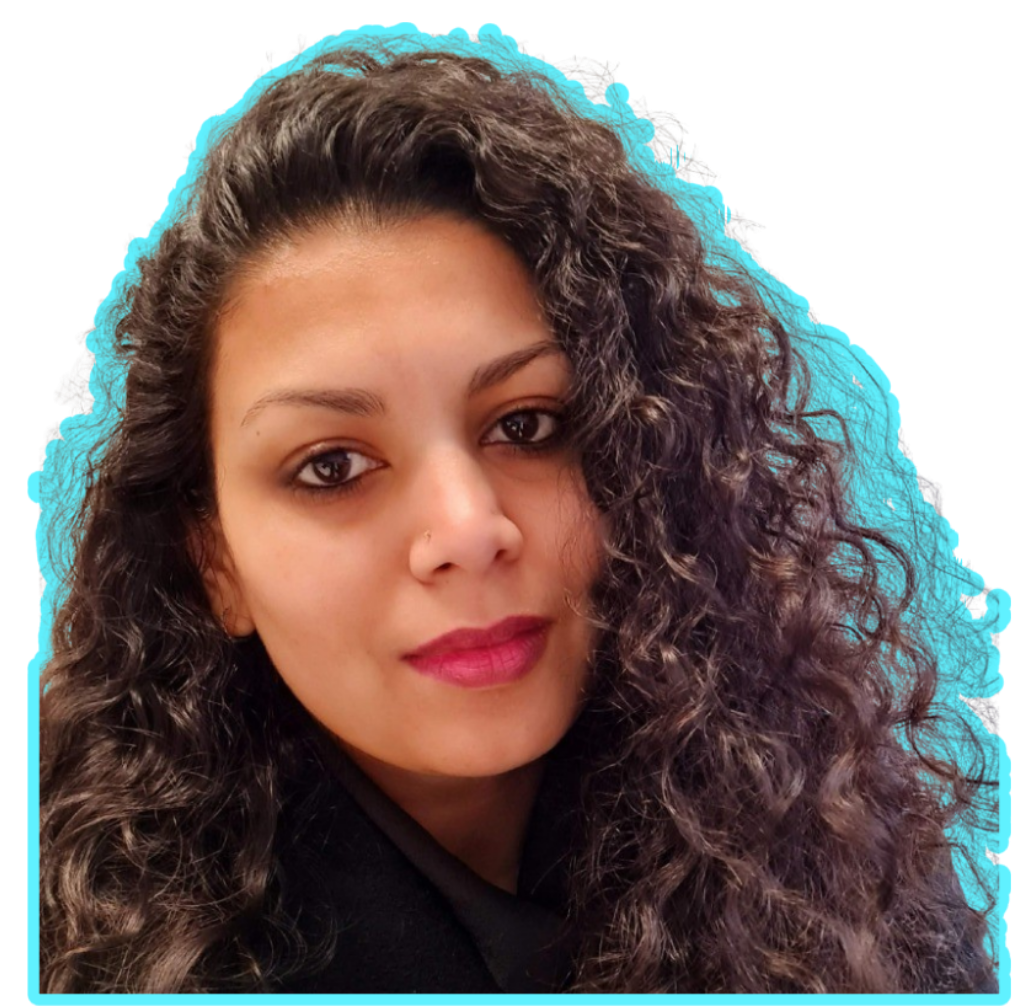
Shweta, in her own words.
← Scroll to watch →
Stuck on a "no" right now? Shweta's cube exercise is waiting for you further down.
↓
Meet Shweta
NataliaGo back to India. Your childhood growing up, can you tell us a little bit about what that was like?
ShwetaI grew up in a small town in India, in a joint family. Just to give you an idea, it was my grandfather, his three brothers, and all of their kids and their kids.
So we were approximately 45 people. We had a humongous house. We still do in India.
I grew up, quite a lot of privileged life, to be fair. The town itself is very close to a large metropolitan city. So we had the best of both worlds: the rural life, all the amenities, and for anything beyond, we could go 30 kilometres away to a larger city and spend a day.
I have really fond memories of India and my childhood, and this beauty in growing up with so many cousins and so many people.
NataliaDo you feel that way of growing up influences your life today and the way you run your business?
ShwetaI think it does. The decision-making, the values, the systems you are brought up with kind of peek through in different things.
In India, we always say it takes a village to raise a child.
I grew up in a family which was large, but even our neighbours behaved more like a family to us. Those lines of who is really family and who is beyond were blurred because of the respect we felt for each other.
The leap to hotel management
NataliaTell me about the decision to come to New Zealand.
ShwetaAs much as I value my childhood, having such a large family also used to feel quite daunting at the time. Imagine as a child: you not only listen to your mother and father, you have grandparents, uncles, aunties, everyone in the house with a say in your life.
It used to feel quite claustrophobic at times.
Especially in your teens, there is a rebellious streak in every teenager. I used to feel: why must I have permission from everyone? I felt I must have the freedom to do what I wanted to.
Choosing hotel management
My family was trying to push me into computer science because it was the up and coming field. It's funny, now my family doesn't stop talking about it just to rub it in my face, because that's exactly what I do now.
But back then, I said no. I knew myself. I'm more of a people person. I felt computer science would be being stuck behind a computer.
So in my naivety, I chose hotel management. I thought, oh my god, travel. I would talk to people. And who knows, in 10, 20 years time, I'll have a hotel of my own.
My father specifically was very disappointed. His message was: you are not listening to me, I don't think this is the right path. I can't stop you, so you go do whatever you want, but don't expect a lot of help and handholding in this aspect.
It was his way of sort of ushering me into the real world.
The phone call from New Plymouth
One of my friends, who used to intern with me in one of the hotels, had come to New Zealand. In New Plymouth. She called me out of the blue, I think it was my birthday.
She said, what are you doing? I explained, gave her my plight. I said, I'm a bit lost.
She said, oh, you must come here. She completely sold me on the idea. Naively, both of us at that point thought it would cost approximately the same amount of money to study in New Zealand as it would to do an MBA in India.
So I started working towards it, and I made it happen.
NataliaHow old were you when you came here?
ShwetaI think about 19, 20, something like that. Very young. And it was wholeheartedly individual decision.
The first night
NataliaWhat was your impression? Was there anything in particular that surprised you?
ShwetaWhen I landed in Auckland, it was a five-hour wait for the domestic flight, which also got delayed. Then I had to wait for another three hours or something. The entire time I was waiting at the airport, it was pouring down.
Oh my God, what have I gotten myself into?
I wasn't alone, luckily. I came with a bunch of students that were going to the same school. There were a bunch of other people that became friends with me, and it was good.
The fridge
When I got to the school, it was about 10.30 at night, and I was the last person to arrive.
The school itself is about eight kilometres away from the main city hub of New Plymouth. The restaurants and everything had been closed. I had no means of travel. The school had a restaurant, but all of it was closed. Everyone else had already made their way to New Plymouth hours before I did. Everyone had gone to bed.
I picked up my room keys, found my room, went in, and opened the fridge.
There was a nougat bar. There was a pack of milk. There was a packet of chips. And I went to bed crying.
I didn't know where my friends were. I couldn't call my parents. At that time there were phone cards, and although I had a mobile, I had to figure out where to get the card. It was so late in the night.
The next morning I woke up, and everything else worked out. I called my parents: okay, I'm here. I'm safe.
The empty streets
But then came the cultural shock. I came from India, where it's filled with people. You see people everywhere.
All the roads were empty. You barely saw any cars. It used to be super quiet.
I walked for a couple of kilometres and wouldn't see a person. You'd barely see someone peeping through a window of their home, or someone working in the garden.
After a month of enduring that, I started feeling super homesick and recounting all my choices.
The only thing that kept me going was, I knew this was my choice, and my choice alone.
The catch-22
NataliaHow did things evolve from there?
ShwetaThe study plan was six months full-time, then six months industry placement. I was accepted at the Carlton Hotel in Auckland, which is now, I think, Grand Millennium or something, on Mayoral Drive.
Telephonist at the Carlton
They basically accepted me initially as a telephonist. I was like, what am I doing with my life? There's nothing wrong with being a telephonist. I was just so adamant that I wanted to be in the event space.
I hated that I had to prove my worth every step of the way.
Anyway, I still enjoyed the job. It was a really nice role. I'd do all the work I needed to and find pockets of time to help other departments.
Sometimes I'd do a 4am shift, four to twelve, and then I'd go and knock on the housekeeping door and say, hey, do you need any help? I wasn't paid for it. I wasn't really looking for it. I just wanted to learn.
So I'd sometimes help the restaurants, sometimes the housekeeping, sometimes the events people, sometimes the front office, even concierge. I was just curious about how the different departments work together.
The front office detour
When my internship came to an end, unfortunately my manager was travelling and there were visa issues. I had no job to go to. I quickly realised my visa would be null and void if I didn't secure another employment.
So I was frantically looking for a job. I secured one, a front office role. That's how I got into front office.
By that time I had realised: yes, events is the place I want to go. But unfortunately this is what I have to do. People are not ready to just take me into an events department. I'll have to show them that I'm capable.
Although I had worked in events and been trained in the events department in India, unfortunately there's a big gap in perception of India over here.
People don't find Indian experience and education get the value it deserves over here.
That's just the way things are, and I sincerely hope it changes. It's very regressive if you ask me.
My tenacity kicked in. I refused to stay in front office. I would only apply for event coordinator, event manager roles. And all I got was rejections.
Heritage Hotel
I went to Heritage Hotel on one of their open days. Someone came asking what kind of role I was looking for. I explained, and they were like, oh yeah, yeah, your experience.
And I asked a question back.
So the catch-22 here is, you want me to have experience. You don't want to take into account the training or experience I already have from India. Unless someone gives me a job, I'm not going to have that experience. So where does that leave me?
He laughed. He said, okay, I understand. He introduced me to the events manager. She was quite kind.
She said, I'll interview you. That's all I can do at the moment. I don't necessarily have a role available.
I said, okay, that's fine. And she interviewed me.
Later there became a role available. She interviewed me again, and she rejected me.
Three or four months later, I saw the same role appear again. I applied again. She must have picked it up. She called me again, and she rejected me again.
Four or five months later, so a year after my first conversation with her, she had put that role out again. I applied again.
The question that changed it
This time I said to her:
Why is it that this role keeps coming up and you don't accept my application? What is it that you think I cannot do?
She was like, oh well, I don't think you have the requisite experience and this and that. And I said, okay, here we go again.
"Why don't you ask me a direct question of, okay, I'm giving you an event to manage, how would you do it. Something that would actually gauge how much I know."
She was quite kind. She said, you know what? You're right. I should ask you those questions. Come back tomorrow. I'll give you an assignment. I'll ask you to organise an event and you have to give me all the steps. You'd have 24 hours to prepare.
I said, "Really not necessary. I already know what I'm going to tell you."
She said, okay, why not we do that now?
The interview turned from half an hour to two hours. I gave her all the steps. She was like, okay, you know what? You have a point. Fine. I'm going to give you a chance.
And I stuck around for three years.
Try it yourself
Turn the cube
Take a "no" you're sitting with right now, and walk it around three sides. Then turn it again to hear what her grandfather had to say.
We are often so bogged down with the only thing we see, and we don't realise there are other sides that other people are seeing.Shweta
1Your side
2Their side
3Outsider's side
Every problem has multiple sides.Her grandfather
Ask what they see.Shweta
Are you seeing the other five?Her grandfather
The three perspectives
Her grandfather's lesson
Your side
What do you see from where you're standing?
Their side
What might the other person see from their side?
Outsider's side
What would someone who knows neither of you see?
Her grandfather said
Every problem has multiple sides.
You're looking at the one square in front of you. There are five more.
Shweta's takeaway
Ask what they see.
For me to tell you, don't you think you have to first ask me what I see?
His question back to her
Are you seeing the other five?
Often we are so bogged down with the only thing we see, that we don't realise other people are seeing different sides.
Your problem, turned
Your "no" goes here
Side 1 · Your side
click and type above to begin
Side 2 · Their side
click and type above to begin
Side 3 · Outsider's side
click and type above to begin
Shweta's grandfather's lesson
The most depressing time of my life
Three years later, I realised this wasn't the field that would satisfy my professional cravings. With this experience, surely there would be companies that require an event manager. Not as a hotel, but as a company.
I started applying for those roles, and nothing came about.
I came to a point where I started questioning every move I had made up until that point. This is exactly what I wanted, I achieved it, and three years later I'm not happy in it. This is not what I want to do with my life.
My husband, who was boyfriend at the time, said: why don't you take a break, leave the job, figure out what it is that you want to do.
So I left the job and went back to India for a couple of months. Travelled around. And just sat in the house for about six months.
That was the most depressing time of my life.
The 15-minute call
I started applying for random jobs. One day I got a call for a sales role at Yellow Pages. He had asked me to come over for an interview. But within 10 minutes he called back and said, maybe this is not for you.
It struck me like a thousand-volt bulb. What do you mean maybe you can't do this? What is it that I cannot do?
There's been a theme in my life where someone tells me, you can't do this, and I want to ask: why do you think so? What is it that I cannot do?
So I asked him: why do you think I can't do this? What about this role do you think I cannot do? And why did you come to that conclusion?
And I said:
Okay, I want 15 minutes of your time. If you are convinced that I cannot do this, you tell me why. Otherwise, I'll convince you that I can.
I must say, I found people who actually gave me the time of day, just to entertain me, I feel. I don't know if people are okay if someone talks to them this way on the phone. I think I was naive, and I was just very outspoken.
He gave me 15 minutes. He was convinced. He said, okay fine, you have enough for me to send you forward as a candidate. I can't guarantee you a job. You go interview with the company. If they like you, they'll take you. Otherwise we are back to square one.
I went and interviewed. I got the job. I was in that role for three, three and a half years.
Building a career
Yellow Pages
I was doing sales, but the majority of my role involved helping businesses understand the new technology, the new landscape. Back in those days, people were still using ledgers.
I was working with Yellow Pages, but they were also one of the first companies to introduce Google framework to businesses. Google AdWords, SEM, SEO. None of this I had learned before. I was not from this field.
I learned all of it from the training they gave me, training Google gave me, and whatever I learned through the general process of working with businesses. Trial and error, a lot of it.
I was very lucky to have had people in my life that saw some spark in me, that challenged me to think differently, that pushed me in directions I was absolutely unfamiliar with. It's great to have people that see something beyond what you see in yourself.
American Express
About three and a half years later, I got a role with American Express in sales again, but in foreign exchange. Completely different ball game.
It was very stressful. I had to learn a whole new field. The first six months was solid learning while I was working. After that, it's just the kind of role where you have to be very hands-on, because the markets are always moving.
Towards the end, I was pregnant with my first child. I found that the stress of the role was hindering my pregnancy. It was not good for me. The midwife sort of said:
You can't have both. You have to choose.
Of course I chose my child. So I called it quits with American Express.
The cafe years
The burger shop
After my son was born, I was really bored one day. My sister-in-law was talking about someone having opened a really small coffee shop. Something about selling a $2 cup of coffee.
I was sitting at home, nothing to do, and I opened TradeMe. There was a listing: someone was selling their cafe for a dollar. I didn't understand how that was possible. They were basically selling the lease.
My husband said, okay fine, let's go have a look. It wasn't going to work out for us, but it gave us an idea.
I found a place in Sandringham available for lease. In those days, finding a place in Sandringham was very, very difficult. A couple of months later, we secured the lease, and we decided to open a burger and ice cream shop.
Just a month before I gave birth, we opened the shop.
The Indian restaurant
Then another lease became available, and we wanted to open an Indian restaurant. We felt everyone just does Punjabi cuisine, and Indian cuisine is so vast.
That was another challenge, because it took a very long time to get council approvals. It ate up a lot of our time and our budget. When we had to open with bare minimum resources, I was running operations at that restaurant for a period of time.
Then COVID
Food businesses take a lot of time to build up. We were just coming to a stage where we were comfortable, and then COVID hit.
We ran through the initial wave. We had not laid off any staff. Everything else was going well. But after COVID, there was a markable dip in all food businesses, and a lot of poaching of good staff.
In our Indian restaurant, we relied so heavily on the chefs. I wasn't trained as a chef, so I couldn't just go into the kitchen and start cooking if he didn't show up. He was given offers in other places. At first, we raised his pay to keep him. But later it became evident this was going to be a recurring theme.
We weren't necessarily in losses. In different circumstances we would have grown those businesses differently, but COVID sort of put a spanner in the works.
So we sold off both businesses. And I went back to corporate work for a couple more years.
Wismopay
NataliaWhat are you doing right now when it comes to your business?
ShwetaOver the years, I've been very lucky to have such an in-depth understanding from running businesses ourselves and consulting with so many different businesses. Not only on advertising or digital media, but overall business operations, foreign exchange, and general banking.
Through that, I understood some of the issues that businesses face.
My husband and I, we always discuss business. Many years ago, we had an idea of something like digital currency. Back then, we had no idea how to do any of it. It was just a dream.
After so many years of working and having felt some of those issues ourselves, we thought: if we can't rely on people to bring about a solution for us, we have to validate if this is a problem for many others and find a solution for it.
The problem
So we decided to incorporate Wismopay. We only incorporated it after we validated the idea.
The problem is the way businesses manage their payments. Mainly merchant services, cards, networks. For many, many years, there hasn't been any remarkable invention in this field. The frauds in the payment industry are at an all-time high. The systems that are in place are not necessarily as effective and efficient as they could be.
What we built
Wismopay helps businesses and users transact with one another with remarkable ease and speed.
It also takes away the overly reliant nature of businesses on the existing payment rails, MasterCard and Visa, which are the reasons we incur such high fees.
When you run a business and you're taking payments, there are so many interchange fees you face. In some way, shape, or form, you're always paying. Government banned some of the surcharges, but in my mind, that's not a sustainable solution.
What we are doing gives businesses a subscription model, more of a fixed cost, so they know exactly how much they're paying for their payment services. And users would not have to pay the surcharges.
Where the doer mindset comes from
NataliaHaving no New Zealand experience, getting rejected, finding your way through. Where do you think that mindset comes from?
ShwetaI have absolutely no idea. I genuinely don't. But I have realised over the years:
The fundamental difference between doers is that they figure out a way to do it.
Failure was never an option for me. I never considered it. It was never on my horizon anywhere. The questions playing in my mind are generally what, when, how, where. Those are the main frameworks I rely on.
Mum and the questions
As a kid, I didn't fit in with the elder cousins or with the younger ones. Often I would have complaints. I'd go to my mom.
Instead of engaging me on my tangent of something is wrong, she would just throw a question at me. "Do you think it may be this?" And she would walk away.
In a household with 40-odd people, people don't have time to sit down and work around your issues. That's first-world problems. That doesn't happen in the third world.
So my mother would simply throw a question at me. "Have you thought about this?" And she would walk away. I'm left to steep in my own trouble and figure it out.
As a child, I learned to unpack a lot of my emotions on my own.
The cube
One of the things my grandfather did, as a child, he took a cube. Like, you know, the Rubik's Cube.
I was complaining about something, as I quite often did. He put that cube in front of me, at eye level. So the only thing I could see was the one square. I couldn't see the top. I couldn't see the sides.
He said: "You must tell me exactly what you see. Forget that you know it's a cube. Just tell me what you see."
First I said, it's a cube. I know it's a cube.
He's like, no, no, tell me what do you see. I finally figured out what he was asking. He said, okay, so you see this one square. And then he turned it ever so lightly.
"Now tell me, what do you see?"
I said, okay, I now see that same square, but I see there is a line, and I see there is maybe another side to this cube. He turned it a little further towards me. What do you see now? I said, okay, now I see the third side of it.
He did that a couple more times. And then he said:
At any time, every problem has multiple sides. Are you looking at the square that you see, or are you considering the other five sides it has as well?
It stuck with me even as a child. I remember it so vividly. He said: "It's just often we are so bogged down with the only thing we see, and we don't realise that there are other sides that other people are seeing."
And he said, okay, so what do you think I am seeing?
I said, I don't know what you see.
He's like, okay, so then what's the logical thing to do? And I said:
For me to tell you, don't you think you have to first ask me what I see? Wouldn't that be the most logical question?
Her chosen family
NataliaSometimes it's a little bit hard as a migrant. When you come here and you don't have your family and you don't have that support network.
ShwetaYes. Especially for migrants. The people that I call my family are not my family at all. They're not my blood relatives.
Yes, of course my husband and my family is there. But some of the other people that have the tag of being my family are, let's say, my soul family.
They see the potential in me. They are invested in my growth.
They are connected with me on a different level. They understand me. They see me. It's important to have people that are really rooting for you.
Your tribe
That's what most of the migrants rely on. Not everyone travels with a family. I've spent most of my life here without any of my blood family here at all. None of my parents, my siblings, my cousins. I come from such a large family, and none of them have been here.
It's unrealistic to expect to suddenly have someone by your side from day one. If you do, you're super lucky, great for you.
But these networks that we have now, whether it is the expat girlies or migrant women in business, these networks are such a godsend.
Had I been part of some of these networks so long ago, maybe my choices would have been different. Or maybe some of my heartache would have been softened a little bit.
I am grateful for all the heartaches and the places where I faltered. Those were the lessons I needed to learn at that time.
Her message
NataliaWhat would you say to a migrant woman thinking about starting a business, or struggling with having no New Zealand experience?
ShwetaDon't sell yourself short. Don't be bogged down by what others may think of you.
People will always find a way to put you in some sort of a cube. It's only you who can decide whether you truly fit into that description or not.
It's better to be outspoken and have the courage to ask your questions rather than keep mum about it. Because if you don't voice your own self, if we don't speak our own mind, no one will speak for us.
Never let anyone limit you. Only we can set a limit for ourselves.
Whether you think you can or you can't, you're always right. If you think you can, you can. If you think you can't, you can't.
You are your best advocate, and you are your worst adversary.
Listen to both
The advocate & the adversary
You have both voices inside you. Write down what each one is saying right now about something you want to chase. Then ask yourself, which one are you going to listen to today?
+
Your best advocate says
The voice cheering you on. What's it whispering?
−
Your worst adversary says
The voice holding you back. Be honest. What's it saying?
Both voices, side by side
+ Advocate
type above to begin
− Adversary
type above to begin
Which one are you going to listen to today?
A message to her younger self
NataliaIf you could look back at the younger version of yourself, packing her bags, getting ready to come to New Zealand. What would you say to her?
ShwetaI would say: learn to ask what they see from the cube. Because I didn't ask that of my parents.
I was so bogged down with what I wanted to do. Maybe if I had asked them why, why do they think so, they could have given me some sort of explanation, which could have changed the course of my life.
Mind you, I am grateful to have led this life. I truly believe this was what I was meant to journey through.
But if I were to go back 20 years, I would definitely learn to ask why.
That's an important question. Why do you think so? Why not ask why?